
Microchip ATMEGA649P-AUR: An In-Depth Technical Overview and Application Guide
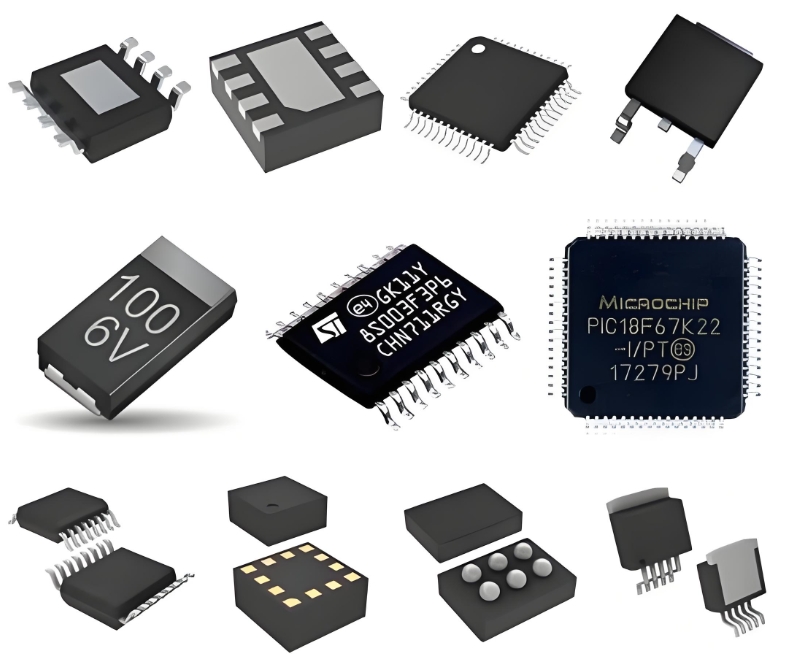
The Microchip ATMEGA649P-AUR is a high-performance, low-power 8-bit AVR RISC-based microcontroller that combines a rich set of peripherals with substantial in-system program and data memory. Housed in a 64-pin TQFP package, this device is designed for complex embedded applications requiring robust I/O capabilities, extensive connectivity, and efficient processing.
Core Architecture and Performance
At the heart of the microcontroller is the advanced AVR RISC architecture, which executes powerful instructions in a single clock cycle. This allows the device to achieve throughputs approaching 1 MIPS per MHz, enabling designers to optimize power consumption versus processing speed. The core operates at a maximum frequency of 16 MHz and features a hardware multiplier that accelerates arithmetic operations.
Memory Subsystem
The ATMEGA649P-AUR is equipped with 64 KB of in-system self-programmable Flash memory for application code, 4 KB of internal SRAM for data handling, and 2 KB of EEPROM for non-volatile data storage. This substantial memory configuration supports the implementation of sophisticated firmware, including protocol stacks, data logging routines, and complex control algorithms without the immediate need for external memory.
Advanced Peripheral Set
A defining characteristic of this microcontroller is its extensive range of integrated peripherals:
I/O Ports: It offers a vast number of general-purpose I/O lines (54 I/O pins) organized into multiple ports (A, B, C, D, E, F, G), most of which feature alternate functions for peripherals.
Communication Interfaces: The chip includes a versatile USART, a Two-Wire Interface (TWI) for I²C communication, and a Serial Peripheral Interface (SPI), providing multiple pathways for communication with sensors, memories, and other microcontrollers.
Analog Capabilities: An 8-channel, 10-bit ADC allows for precise analog sensor data acquisition. Furthermore, it features an analog comparator for quick threshold detection.
Timers and Control: Four flexible 8/16-bit timers/counters with PWM support, including a high-speed 8-bit timer, are ideal for motor control, waveform generation, and real-time event management.
JTAG Interface: This supports not only boundary-scan for production testing but also on-chip debugging (OCD), which significantly simplifies the firmware development and troubleshooting process.
System Management and Robustness
The device incorporates several mechanisms to enhance system reliability. These include a programmable Brown-out Detection (BOD) circuit to monitor power supply levels, an internal calibrated oscillator removing the need for an external crystal in less timing-critical applications, and multiple power-saving sleep modes (Idle, ADC Noise Reduction, Power-save, Power-down, Standby, and Extended Standby) to minimize energy consumption in battery-operated devices.
Key Application Areas
The combination of high pin count, ample memory, and diverse peripherals makes the ATMEGA649P-AUR suitable for a wide array of demanding applications. It is an excellent choice for:
Industrial Control Systems: PLCs, sensor hubs, and control panels.
Advanced Human-Machine Interfaces (HMI): Driving keypads, LCD displays (it features a dedicated segment LCD driver in the 649 variant), and touch inputs.
Automotive Electronics: Body control modules, dashboard instrumentation, and aftermarket accessories.
Building Automation: Thermostats, security systems, and lighting control units.
Sophisticated Consumer Devices: Appliances, gaming accessories, and data loggers.
ICGOOODFIND
The Microchip ATMEGA649P-AUR stands out as a highly integrated and capable 8-bit microcontroller. Its robust set of peripherals, significant memory resources, and comprehensive system management features make it a powerful and versatile solution for engineers designing complex embedded systems that require extensive I/O control, connectivity, and reliable operation in various environments.
Keywords:
1. AVR Microcontroller
2. Embedded Systems
3. Peripheral Integration
4. In-System Programming
5. Low-Power Operation

